
A Practical Guide to Energy Efficiency and Compliance
Obtaining an energy performance certificate Stonehouse is an important step for property owners preparing to sell, let or assess the energy efficiency of their building. An Energy Performance Certificate (EPC) provides an official rating that indicates how efficiently a property uses energy under standard assessment conditions. From traditional homes influenced by Stonehouse’s industrial heritage to modern residential developments, various building characteristics can affect the final result.
Understanding EPC requirements can help homeowners, landlords and commercial property owners make informed decisions before arranging an assessment. The EPC certificate includes information about estimated energy costs, environmental performance and recommended improvements that could increase efficiency. Knowing what to expect during an EPC inspection and how ratings are calculated can provide greater clarity throughout the certification process.
At EPC Bright, we help property owners in Stonehouse understand their building’s energy performance and meet relevant certification requirements through professional EPC assessments. Email or contact us today on 0117 203 4329 to arrange an EPC appointment and take the next step towards better energy efficiency and regulatory compliance.
When Is an Energy Performance Certificate Stonehouse Legally Required?
An energy performance certificate Stonehouse is generally required when a qualifying residential or commercial property is marketed for sale or rent. The energy performance certificate must be available to prospective buyers or tenants within the relevant legal timescales, and property owners should check whether a valid assessment already exists before commissioning another. An EPC certificate normally remains valid for 10 years, although certain buildings and transactions qualify for exemptions under government regulations.
Property Transactions That Require EPC Certification
The need for EPC certification depends on the building’s intended use and the circumstances surrounding its sale, rental or construction. Identifying the relevant requirements early can help property owners avoid delays and ensure the necessary documentation is available when required.
Common situations where an EPC may be required include:
- Selling a residential property that does not have a valid EPC
- Advertising a house or flat for rent to prospective tenants
- Marketing qualifying offices, retail units or other commercial premises
- Completing a newly constructed property that requires energy certification
- Replacing an expired EPC before an eligible sale or letting
- Providing energy performance information to prospective property buyers
At EPC Bright, we help property owners understand their legal obligations and arrange the appropriate EPC assessments for sales and lettings. Call us today on 0117 203 4329 for clear guidance on when your residential home or commercial building in Stonehouse requires energy certification.
Understanding Energy Performance Certificate Stonehouse Ratings
An energy performance certificate Stonehouse provides a standardised rating that helps residential and commercial property owners evaluate their building’s energy efficiency. Both domestic and non-domestic EPCs use ratings from A to G, with A representing the highest standard efficiency band and G the lowest, although their assessment methods differ. The EPC certificate provides information about current energy performance and potential improvements, helping homeowners, landlords and business owners make informed decisions about their properties.
How Domestic and Commercial EPC Scores Compare
Domestic and commercial EPC ratings use different scoring systems to assess building performance. Domestic ratings are based on estimated energy costs, while non-domestic ratings use calculated carbon dioxide (CO₂) emissions compared with a reference building. The table below outlines the standard EPC rating bands and corresponding scores for residential and commercial properties in England and Wales.
| EPC rating | Domestic EPC score | Commercial EPC score | General interpretation |
| A+ | Not applicable | Below 0 | Net-negative modelled CO2 emissions |
| A | 92+ | 0–25 | Highest standard efficiency band |
| B | 81–91 | 26–50 | Very good efficiency |
| C | 69–80 | 51–75 | Good efficiency |
| D | 55–68 | 76–100 | Moderate efficiency |
| E | 39–54 | 101–125 | Lower efficiency |
| F | 21–38 | 126–150 | Poor efficiency |
| G | 1–20 | Above 150 | Lowest efficiency band |
Unlike domestic EPC scores, higher commercial asset-rating scores indicate poorer energy performance. Commercial properties can also achieve an A+ rating when their calculated net CO2 emissions fall below zero. Actual energy consumption may differ from assessed performance depending on each building’s occupancy, operating hours and usage patterns.
At EPC Bright, we provide professional domestic and commercial EPC assessments to help property owners in Stonehouse understand their energy ratings and identify opportunities for improvement. Phone us today on 0117 203 4329 to discuss your EPC results and find out what your property’s rating means for its energy performance.
How Is an Energy Performance Certificate Stonehouse Assessment Carried Out?
An EPC assessment involves inspecting a building’s construction, internal dimensions and fixed energy-related installations to evaluate its energy performance. Accredited EPC assessors use approved calculation methodologies, including the Standard Assessment Procedure (SAP) or Reduced Data SAP (RdSAP) for residential properties, and the Simplified Building Energy Model (SBEM) or Dynamic Simulation Modelling (DSM) for commercial premises.
Under the Energy Performance of Buildings (England and Wales) Regulations 2012, energy assessors must be members of an approved accreditation scheme and meet the relevant qualification requirements for the buildings they assess.
(Source: https://www.legislation.gov.uk/uksi/2012/3118/part/5)
What Happens During an EPC Inspection?
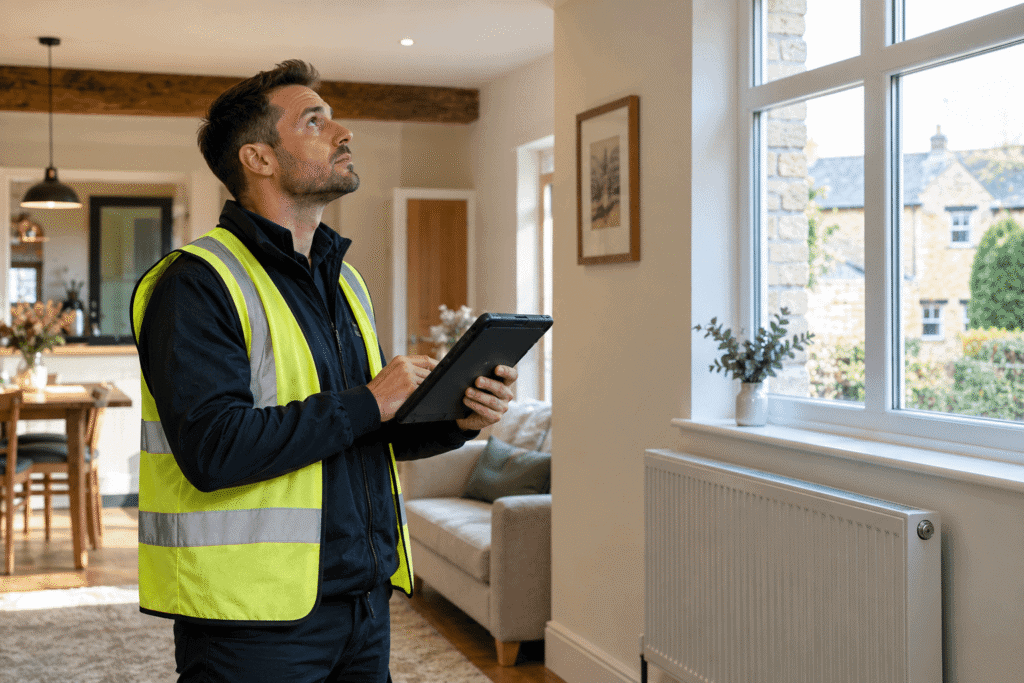
An EPC inspection is normally non-invasive, with the accredited assessor examining accessible building features and reviewing supporting evidence where necessary. Preparing relevant documentation beforehand can help establish accurate construction details and ensure that energy efficiency improvements are properly recorded during the EPC assessment.
Before your energy performance certificate Stonehouse assessment, useful preparations include:
- Clearing access to loft hatches, heating equipment and relevant rooms
- Locating certificates for previously installed cavity wall or loft insulation
- Providing documentation confirming window and glazing specifications
- Making boiler manuals and heating system information available
- Gathering installation records for solar panels or heat pumps
- Preparing available floor plans for larger or more complex premises
At EPC Bright, our energy assessors are members of an approved accreditation scheme and are appropriately qualified to carry out EPC inspections for domestic and non-domestic properties across Stonehouse and other locations throughout South West England and South Wales, including:
- EPC Certificate Bath
- EPC Certificate Bristol
- EPC Certificate Stroud
- EPC Certificate Taunton
- EPC Certificate Swindon
- EPC Certificate Newport
- EPC Certificate Clevedon
- EPC Certificate Gloucester
- EPC Certificate Keynsham
- EPC Certificate Portishead
- EPC Certificate Tewkesbury
- EPC Certificate Weston-super-Mare
- EPC Certificate South Gloucestershire
Whether you own a residential or commercial building in Stonehouse or any of our other service areas, we can help you meet the relevant energy certification requirements. Complete our online contact form today or call 0117 203 4329 to book an EPC assessment with our team of accredited energy assessors.
Improving Your Energy Performance Certificate Stonehouse Rating
Improving an energy performance certificate rating starts with identifying the features responsible for unnecessary heat loss and inefficient energy consumption. Suitable energy-saving upgrades can increase indoor comfort, reduce estimated running costs and enhance a building’s long-term appeal. Stonehouse has a varied property landscape, from older homes reflecting its industrial heritage to converted buildings and modern residential developments, making it important to choose energy efficiency measures that suit each property’s age, construction and existing condition.
Practical Energy Improvements Worth Considering
An energy performance certificate Stonehouse can highlight opportunities to improve thermal performance and reduce energy demand without undertaking unnecessary building work. Property owners should consider installation costs, expected benefits and technical suitability before deciding which recommendations to implement.
Depending on your property’s construction and existing equipment, potential improvements include:
- Adding suitable loft insulation to reduce heat loss through the roof
- Installing appropriate wall insulation following a building assessment
- Upgrading inefficient boilers or other fixed heating equipment
- Fitting programmable thermostats and improved heating controls
- Replacing inefficient fixed lighting with LED lighting fixtures
- Insulating suitable hot water cylinders and exposed pipework
- Considering solar photovoltaic panels where installation conditions permit
For commercial premises, reviewing HVAC systems can identify further opportunities to improve heating, cooling and ventilation efficiency. The effect on CO2 emissions and running costs will depend on each building’s current energy performance, the upgrades installed and actual energy consumption.
At EPC Bright, we provide detailed energy performance information to help Stonehouse property owners identify suitable priorities for future improvements. Reach out to us today on 0117 203 4329 to schedule an EPC assessment before planning energy efficiency upgrades for your property.
Energy Performance Certificate Stonehouse and Landlord Compliance
Landlords in Stonehouse must consider energy efficiency regulations when renting residential and commercial properties. Under the Minimum Energy Efficiency Standards (MEES), qualifying privately rented buildings in England and Wales must generally achieve at least EPC band E, unless a valid exemption has been registered. The requirements apply to relevant new and existing tenancies, making compliance an ongoing responsibility for landlords.
An energy performance certificate Stonehouse with an F or G rating can indicate that action is needed to meet the applicable standard. Depending on the property’s circumstances and the regulations governing the tenancy, landlords may need to undertake eligible improvements, establish whether the tenancy falls within the regulations or register an exemption supported by appropriate evidence.
The UK Government provides detailed guidance on MEES requirements for both domestic and non-domestic privately rented properties in England and Wales. The guidance explains landlords’ legal responsibilities, the circumstances in which exemptions may apply, the evidence required to support exemption registrations and the enforcement measures for non-compliance.
Landlords in Stonehouse can refer to the official UK Government guidance for domestic and non-domestic privately rented properties to understand the regulations applicable to their buildings.
Sources:
Domestic and Non-Domestic EPC Compliance Considerations
Residential and commercial landlords face different practical considerations when managing EPC compliance. Domestic properties are assessed using methodologies designed for homes, while non-domestic assessments account for commercial building characteristics and fixed services. Establishing the correct EPC assessment category is particularly important for converted premises, buildings containing multiple units, and properties combining residential and business use.
Important considerations for landlords include:
- Residential tenancies: Confirming whether the property falls within MEES and reviewing any outstanding energy efficiency recommendations.
- Commercial leases: Checking the tenancy terms, EPC requirements and suitability of proposed upgrades for the building’s intended use.
- Registered exemptions: Establishing whether circumstances such as improvement costs, required third-party consent or technical restrictions meet the relevant criteria.
- Supporting documentation: Retaining installation records, contractor quotations and other evidence needed to demonstrate completed improvements or support an exemption.
- Mixed-use properties: Determining whether separate domestic and non-domestic EPC assessments are required for different parts of the building.
- Future regulations: Following confirmed policy developments that may affect refurbishment budgets, investment decisions and long-term letting arrangements.
At EPC Bright, we provide domestic and commercial EPC assessments to help landlords understand their buildings’ energy performance and make informed decisions about certification requirements and future expenditure. Speak to us today on 0117 203 4329 to arrange the appropriate EPC assessment for your rental property in Stonehouse.
Why Choose EPC Bright for an Energy Performance Certificate Stonehouse?
Choosing an EPC provider requires confidence in the assessor’s accreditation, technical knowledge of building performance and ability to deliver certificates within the required timescales. EPC Bright supports residential and commercial property owners across Stonehouse with EPC requirements for property sales, lettings and building management. Our wider services include support with Minimum Energy Efficiency Standards (MEES) compliance, helping landlords understand their obligations and identify appropriate next steps. We also provide Legionella Risk Assessments to help property owners and facilities managers identify potential water system hazards and manage associated safety risks.
Established Experience, Accredited Assessments and Clear Reporting
EPC Bright’s transition from JackRey Services reflects the continuation of an established service focused on accurate energy assessments and straightforward customer communication. Our approach to providing Energy Performance Certificates centres on professional assessment standards, reliable documentation and practical information that property owners can use with confidence.
Key features of our EPC Stonehouse services include:
- Arranging EPC inspections through appropriately accredited energy assessors
- Providing EPC certification for residential and qualifying commercial buildings
- Applying recognised calculation methodologies suited to the relevant property category
- Recording relevant building measurements, construction details and fixed energy installations
- Considering supporting documentation when assessing improvements that require additional evidence
- Preparing EPC reports using approved energy assessment software
- Lodging completed certificates on the official EPC Register
Whether you are preparing to sell your home, let a commercial premises, or review your property’s energy efficiency, obtaining accurate energy certification can help you make informed decisions about its future.
At EPC Bright, we can guide you through the EPC assessment process, from arranging an inspection to understanding the information provided in your completed certificate. Discover how our accredited energy assessors can support your property’s energy certification needs. Get in touch with us today on 0117 203 4329 for an initial consultation before arranging a suitable EPC assessment for your residential or commercial property in Stonehouse.
Frequently Asked Questions About Energy Performance Certificate Stonehouse
1. What is an energy performance certificate Stonehouse?
An energy performance certificate Stonehouse (EPC) is an official document that assesses the energy efficiency of a residential or commercial property. It provides an energy efficiency rating from A (most efficient) to G (least efficient), alongside recommendations for improving energy performance. The EPC assessment considers various aspects of the property, including its heating systems, insulation, and building construction. An EPC helps property owners, buyers and tenants understand how efficiently a building uses energy.
2. Do I need an energy performance certificate when selling my property in Stonehouse?
Yes, homeowners selling a property in Stonehouse generally need a valid energy performance certificate before putting it on the market. This requirement applies to most existing homes and newly completed residential properties. For a new build property, the energy assessment typically involves a SAP Calculation, which evaluates the building’s predicted energy performance based on its design, materials, and installed systems. Certain properties may qualify for exemptions.
3. How long does an energy performance certificate Stonehouse remain valid?
An energy performance certificate Stonehouse is generally valid for 10 years from the date of issue. During this period, it can be used when selling or renting a property without requiring a new assessment. However, significant improvements, such as installing underfloor heating, upgrading insulation or replacing outdated windows and doors, may justify obtaining a new certificate to reflect the property’s improved energy efficiency.
4. How much does an energy performance certificate Stonehouse cost?
The cost of an energy performance certificate Stonehouse depends on each property’s size, type, layout and assessment requirements. Features such as multiple storeys, complex heating systems or a commercial development may influence the time and expertise required. Commercial properties can also have different assessment requirements from residential buildings. Contacting our accredited energy assessors at EPC Bright is the best way to obtain an accurate quotation for your property.
5. What happens during an energy performance certificate Stonehouse assessment?
During an energy performance certificate Stonehouse assessment, our accredited energy assessor examines key features affecting your property’s energy efficiency. These may include the insulation beneath your pitched roof, the type of triple or double glazing installed, heating systems, and the construction of external walls. Our team may also consider your ground floor construction, including whether the property has solid, suspended or insulated floors. The collected information is then used to calculate your building’s energy efficiency rating.
6. How can I improve my EPC Stonehouse rating?
Improving your EPC Stonehouse rating may involve upgrading loft insulation, improving heating controls, installing energy-efficient glazing and reducing unwanted heat loss. Properties with wooden floors may benefit from suitable floor insulation, particularly where suspended timber floors allow cold air to circulate beneath them. Other improvements, such as modern heating systems and renewable energy technologies, may also help increase your property’s energy efficiency.
7. Is an energy performance certificate required for rental properties in Stonehouse?
Yes, most privately rented properties in Stonehouse require a valid energy performance certificate before being marketed to prospective tenants. Landlords must also comply with applicable Minimum Energy Efficiency Standards (MEES), which generally require a minimum EPC rating of E unless a valid exemption applies. Together, these requirements help prospective tenants make informed decisions about energy efficiency while encouraging landlords to maintain compliance with relevant regulations.
8. How long does a domestic EPC Stonehouse assessment take?
A domestic EPC Stonehouse assessment for a typical residential property usually takes approximately 30 to 60 minutes, although larger or more complex buildings may require additional time. The assessor examines relevant energy-related features and records the information needed to calculate the rating. Once completed, the certificate is lodged on the official EPC register, where it can be accessed by property owners and other interested parties.
9. Can I get an energy performance certificate for a commercial property in Stonehouse?
Yes, a commercial EPC Stonehouse can be obtained for eligible business properties, including offices, retail units, warehouses and other non-domestic buildings. Commercial EPC assessments consider heating, ventilation, cooling, lighting and insulation. Certain public buildings may also require Display Energy Certificates, although these serve a different purpose by showing actual energy consumption rather than the asset-based efficiency rating provided by an EPC. Our appropriately accredited non-domestic energy assessor can advise you on the relevant requirements.
10. How do I book an energy performance certificate assessment?
At EPC Bright, we make obtaining your EPC in Stonehouse simple and straightforward. You will typically need to provide your property’s address, building type, approximate size, and its relevant construction details. Our accredited energy assessor will then carry out the necessary assessment, with your certificate issued once the results have been lodged on the official EPC register.
Call us now on 0117 203 4329 to schedule a convenient appointment and take the first step towards obtaining your Energy Performance Certificate in Stonehouse.